

In its 2026/IV issue, the magazine Diplomacy&Trade devoted its italian focus to Confindustria Ungheria, interviewing its President, Roberto Massucco. We reproduce the main passages by kind permission of the magazine. Confindustria, Massucco explains, is the «union of the entrepreneurs», «sitting with the government and with the unions to discuss about labor laws, labor conditions, in a networking environment and, let's say, representing the interests of businesses before the government for laws about the enterprises».
«We want to do something like that in Hungary but it takes time because you need to build trust and reliability that is not something that you do overnight. You don't just sell yourself; you need to prove yourself to people and to institutions.» The association is a young organization, with a past of less than four years and, at the beginning, absolutely no structure or administration. «Now, we are in the process of building a credible institution, which is not always easy if we take into consideration the ‘Italian DNA' rooted in hundreds of years of our history. In the 12th-13th centuries, Italy was made up of small municipalities taking care of their own interests, thus becoming individualistic and hard to become convinced to join associations.»
«That's really one limit we are facing, but we are moving on. We are also making a business network as I feel that an organization aiming to help enterprises and its members helping each other need to build up a kind of network – by yourself, you cannot move ahead.» Why join? The President recalls the price of electricity skyrocketing a few years ago, with companies starting to complain. «Whether our intervention influenced the decision or not, I cannot say, but after ten days or so, the government put a price cap to the energy. This is our role: to go and represent an interest. So why join us? Because at that point you have something bigger that can represent your interest to an institution.» On the country's appeal, Massucco notes that Hungary has built one of the strongest industrial economies in Central Europe.
Industry accounts for about 31% of GDP, one of the highest proportions in the European Union, with exports now reaching over EUR 149 billion and automotive — batteries and road vehicles included — above 35%.
Those figures, for the President, show where to look. «This explains why Italian companies, known for their expertise in industrial machines, automation, precision engineering, etc. could be interested. However, we also have to think that in ten years from now, the turning point will be the circular economy, the environmental technologies.» According to Eurostat, Italy reached almost 21% circular material usage rate, the second highest in Europe, against a European average of about 12% and 8% in Hungary. «So, there is significant room for improvement in which Italian companies could really do a lot in Hungary in the fields of recycling, waste management, circular economy, sustainable energy, water treatment or industrial energy efficiency where Italy is really one of the top players in Europe.»
Confindustria Ungheria currently has about 50 members and focuses on workshops — the automotive sector, legal matters, tax issues discussed with experts. «I'm not ashamed to admit that now, we are lacking the big Italian companies. Large companies do not need legitimacy from Confindustria Ungheria. On the contrary, their presence would give greater legitimacy to Confindustria Ungheria itself. We are still small but we have already shown that size and credibility are not always the same thing.»
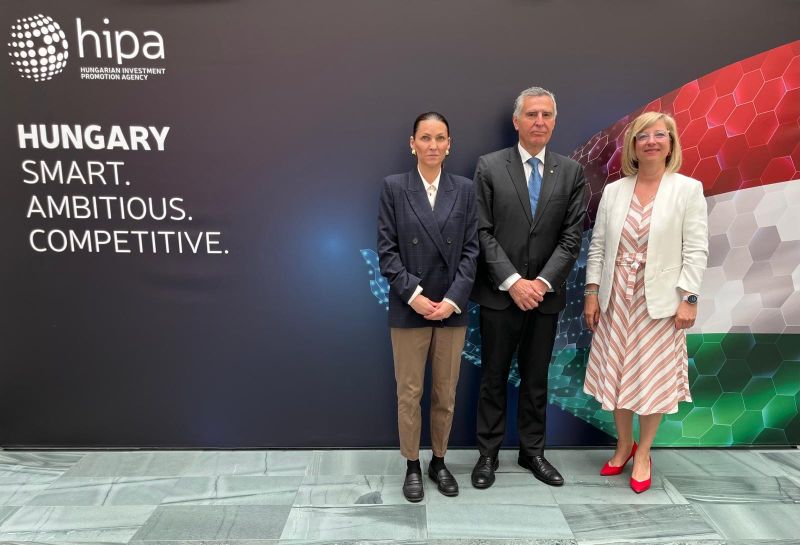
The association has also started a very good cooperation with the British and French Chambers of Commerce in Hungary, has long-standing relations with the investment promotion agency HIPA and with the Federation of Hungarian Industrialists (MGYOSZ), which — like Confindustria Ungheria — belongs to BusinessEurope, as well as with the Embassy of Italy, the Italian Trade Agency (ICE) and the CCIU in Budapest: «We are integrated with the Italian community while being totally independent of governments.» (Interview published in Diplomacy&Trade, 2026/IV, p. 16, and online since 24 August 2026 at dteurope.com — reproduced by kind permission of the magazine; photo by Dávid Harangozó.)